The Screenwriter’s Voice: Part Two

We know what a screenwriter’s voice is now: their style, their tone, their personal outlook on the world of their story, condensed into the prose of their scripts. Next question is: how do you develop one? Well, you can ask yourself a few questions…

What’s your brand? Hollywood screenwriter Doug Eboch has an excellent blog post on what branding means to a screenwriter, and how to use it, here http://letsschmooze.blogspot.co.uk/2013/05/whats-your-brand.html

Branding is what puts your name at the top of the list for a particular genre (and yes, there are lists!) Branding is what separates you from all the other writers who can write in your genre.

Your voice contributes enormously to the perception of your brand, and you need to think about how the way you write relates to the person you are. Are you witty? Precise? Apparently chaotic, or laser-focused? Laddish and matey, or formal? This is why imitating someone else’s voice won’t get you anywhere. There’s no point in your work being a shallow ripoff of Shane Black or Aaron Sorkin if it doesn’t match you.

What’s your genre?  If your voice is hilariously funny, but you write tragic family melodramas, you can guarantee anyone reading them will misinterpret your intentions. If you write horror or thrillers, your voice had better be fast-paced and able to create tension. If your work is slow-build character pieces, you need to be able to conjure up a world of internal emotion in a sentence or two. Develop a voice that reinforces the world you want to create.

Your voice, or your character’s? This is something of a delicate balancing act. If, say, your story world is drily funny and your hero is sarcastic and snappy, then your prose voice should reflect that to an extent. But if your voice is exactly the same as your central character’s dialogue voice, their individuality may disappear into a generalised sea of snark. Whatever your voice, your characters must still stand out as individuals, recognisably part of your world but not inseparable from it.

Shorter is better.  A novelist can afford to develop a voice that rambles, that goes off in random directions, that luxuriates in complex words and rich description. A screenwriter can’t. Even if you make a point of your work being erudite and grammatically rich, it still has to get the job done quickly and efficiently.

Don’t get too hung up on it.  Which seems like a contradictory thing to say, after two posts on the subject, but in the end, voice isn’t the thing you’re selling. It’s a sign of professionalism and an indicator of talent, but it’s a bonus feature, not the main attraction. If the story you’re telling is intriguing and emotionally compelling, you can pretty much forget all about voice.

But then, if the story you’re telling is intriguing and emotionally compelling, you’ll probably find you develop a voice to tell it in anyway…

The Screenwriter’s Voice: part one

Possibly the hardest thing for a screenwriter is learning how to handle the words on the page. Not the dialogue: we all know how people speak, in movies and in real life. Not even the layout and formatting rules: we can learn those.

Not, the tricky bit is learning how to actually describe the action of the movie in a way that not makes sense on the page, but accurately, excitingly conveys something that’s going to be seen and acted to a tired, over-worked reader skimming though a pile of scripts.

It’s the equivalent of a novelist learning how to write elegant, evocative prose. But anyone who has any desire to be a novelist has read novels. Few film fans ever go as far as to read screenplays, not until they actually decide they want to write movies.

So, step one is obvious: read every screenplay you can, old and new, successful and unsuccessful.

And one of the things you’ll notice is – every screenwriter has their own voice.

Which makes sense, of course. If you gave the same plot to John le Carre and to Helen Fielding, you’d expect the feel, the tone, the style of the finished piece to be very different. It’s the same with screenwriters. Compare this snippet of Lethal Weapon, by Shane Black –

Okay. Okay. Let’s stop for a moment. First off, to describe fully the mayhem which Riggs now creates would not do it justice. Here, however, are a few pointers:  He is not flashy. He is not Chuck Norris. Rather, he is like a sledgehammer hitting an egg. He does not knock people down. He does not injure them.

He simply kills them. The whole room. Everyone standing.

To this, the very first words of The Bourne Ultimatum by Tony Gilroy, Scott Z. Burns, and George Nolfi:

EXT.   NIGHT.   HOUSING PROJECTS — MOSCOW          

 SMASH CUT

MOTION — flat out — it’s us — we’re running – stumbling — breathing rushed — blood in the snow…

We are JASON BOURNE and we’re running down an alley…

Supered below:   MOSCOW

BLUE LIGHTS — from the distance — strobing through the night — rushing toward us — POLICE CARS — three of them -

- SIRENS HOWLING as they bear down — closer — faster — until they whip past the alley…

Up against the wall — BOURNE is hidden in the shadows.


Pretty different, huh?

Developing a distinctive voice is important to a screenwriter for several reasons.

It will mark you out from the crowd.  Think back to that script reader trawling through submissions, looking for the one that’s going to make their career. They’ve been reading flat, workmanlike, even awkward, prose all day. Give them something that amuses them, or gets their pulse racing, and you’re already ahead of the competition.

It shows professional confidence. You’re not slavishly copying what you read in a screenwriting manual, or ripping off your favourite writer. You have the confidence to do things your own way. On a related note:

It shows experience.  It takes a little time to develop your own style, and that suggests you’ve written a few screenplays, and learned lessons from them. You’re someone who’s taken time to learn their craft, and who takes their profession seriously.

It shows an understanding of genre and tone.  A comedy screenplay that actually gets the reader laughing (harder than you’d think!), a horror screenplay that sets the reader’s heart racing. These say that you know your genre, and you’re using all the weapons at your disposal to create the desired effect. Even the actual words on the page, which the audience will never know.

So, if I’ve convinced you that an authorial voice is a good thing, come back in a few days for my next post, and we’ll talk about how you can develop one…

Writing For Children’s Television event, Birmingham

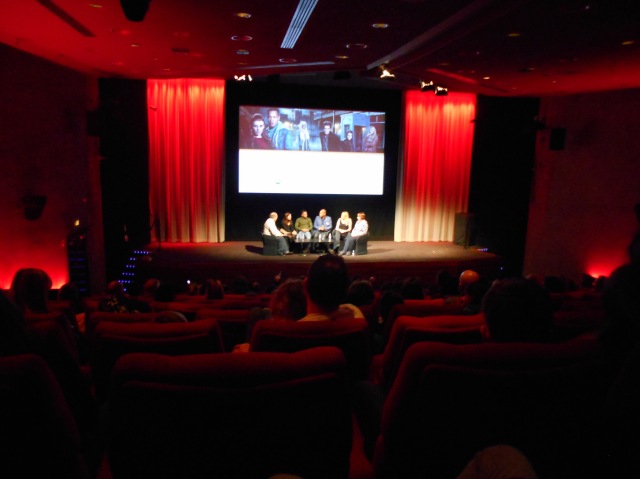
If you’re around Birmingham on Friday 14th June, you can see me, Wolfblood script editor Jonathan Wolfman, and Cheryl Taylor, controller of CBBC, talking about writing for children’s television at a Writer’s Guild event. You can find more details, and book a place, via 

http://www.writersguild.org.uk/news-a-features/events/397-writing-for-childrens-television-birmingham

Should be an excellent evening, and I hope to see some of you there!

The Quest

Anyone who already follows the Go Into The Story blog will already know about this – and if you’re a screenwriter and you’re not, get following! – but…

Last year, screenwriter, writing teacher and blogger Scott Myers ran an opportunity for newer writers called The Quest. Writers submitted a movie logline they’d like to write, and several were picked for a free six-month online… well, part writing class, and part intensive script development. Across those six months, the script moved from logline to completed first draft, via online teaching, seminars, feedback and strict deadlines.

It now turns out that one of the scripts written during The Quest has landed its writer a manager –  and better yet, Scott will be running The Quest again in a mere few weeks!

Full details at  http://gointothestory.blcklst.com/2013/04/countdown-to-the-quest-initiative-26-days.html .  PLEASE READ THE RULES CAREFULLY. especially the part about not submitting anything until May 20th…

If you’re remotely interested in cracking the Hollywood market, or in intensively developing a movie idea and becoming a better writer in the process, this is an opportunity not to be missed…

Things I Learned from… Trance

Art heist thriller Trance has had an interesting journey to your local cinema. Joe Ahearne’s script was originally a TV movie in 2001, but has now been picked up by British wunderkind Danny Boyle, polished by John Hodge, and hit the big screen.

In the end, Trance is a good old-fashioned thriller, and there are three things a thriller has to deliver:

Mystery. Someone is after our hero and he doesn’t know why. Something bad has happened around him, and he doesn’t know why – or even what. The danger is very clear, but what’s triggered the crisis is shrouded in mystery, and must be uncovered if the hero is to survive.

Conspiracy. The hero doesn’t know who to trust. Anyone could be out to get him – and frequently is. At times, the entire world of the movie seems to be ranged against him.

Betrayal. It’s no accident that the femme fatale was created by the thriller genre. There’ll always be someone who gets close to the hero specifically in order to betray him, and others who turn on him because it seems like the right or just thing to do.

Trance delivers admirably on all these elements, at first at least, and yet it’s a movie that’s left a lot of viewers feeling frustrated and unsatisfied. But why?

I think it may be because the movie effectively switches protagonists – and for a thriller, that’s fatal.

It isn’t giving away anything much to say that, about halfway through the movie, we start to spend a lot of time with hypnotherapist Elizabeth, as she becomes caught in a love triangle. From that point, Simon seems less and less like our protagonist -

And the thriller genre revolves around a clearly identified protagonist, because it’s only through him that we can experience that visceral thrill of mystery, conspiracy and betrayal. To feel the thrill of the thriller, we have to have a single, limited perspective – and if anyone else is also a protagonist, then our perspective is changed. They have new pieces of the mystery, they stand outside the conspiracy, they occupy a new place in the web of betrayals.

So, the moment we begin to see things from Elizabeth’s view as well as Simon’s, the three pillars of the thriller structure collapse and the visceral joy of the genre is gone…

Two For the Price Of One

I took my friend’s daughter to see Jack The Giant Slayer the other day, and it got me thinking – what’s with this sudden tendency to have secondary heroes in fantasy movies?

Jack The Giant Slayer has both Jack himself – the typical fairy tale hero, the ordinary lad who must rise to the chance of adventure – and Elmont, the heroic bodyguard/warrior who helps to protect Princess Isabelle. Snow White And The Huntsmen, very much in the same genre, has both the Huntsman and a prince who’s set up as a childhood love interest. Both are instrumental to the story in different ways.

And though it sits in a very different genre, the movie that’s responsible for all these teen-audience, romantically-tinged movies being made is Twilight – and there again, we have two male leads locked in a romantic triangle with the female lead.

Now, I’m all in favour of strong secondary characters. The more striking, attractive and compelling your supporting characters are, the better your movie will be.

But I’m also a fan of the idea of ‘character function’: the idea that each character plays a role within the story, in the same way every mechanic in a Formula One pitstop has a specific job to perform, all of which make up a whole event. Depending on the complexity of your story, you can define those functions in broad terms (love interest, villain, reflection/sidekick), or in more specific terms – for example, all the characters in a heist movie are thieves, but they all have a different role to play in the theft and in the movie.

The golden rule is: no two characters in your movie should be doing the same thing within the plot structure, even if they’re very different characters.

For an example of what happens when you ignore this, take a look at the Christopher Ecceleston season of Doctor Who. Much fantastic stuff in this season, of course: but once Captain Jack Harkness comes aboard the Tardis, something starts to feel amiss. Which is weird, because he and the Doctor are very different characters… Until you realize they both have the same character function:  “slightly madcap alien with advanced knowledge and technology”. Every time the writers come up with a plot twist, Jack and the Doctor are likely to react to it in the same way – and that’s the death of drama. They’re both fascinating characters, but they don’t belong in the same show.

Snow White and The Huntsman suffers from this problem, and has to resolve it by effectively shunting its Prince Charming character out of the plot – minimizing his screen time and his role in the story. Jack The Giant Slayer fares slightly better, partly by making Elmont a seasoned, near-indestructible warrior and Jack a simple farm boy, which allows for differences in both their actions and their reactions. But as Jack begins to grow into the warrior role, the story inevitably starts to suffer from too many heroes.

So why are writers, producers and directors allowing this to happen? I still don’t know. The moral of this particular fairy tale is: too many heroes spoil the broth…

Wolfblood Season Two update

DSCF0181

No exciting updates, I’m afraid; this post is here mainly to funnel all the questions I’m getting sent and all the web searches for ‘Wolfblood season two’ into one place, and make it easier for Wolfblood fans to find the information they’re looking for.

So –  season two is now about halfway through filming, and despite heavy snowfall causing all kinds of problem, we’re back on track and everything is going well.

To answer the three main questions I’m getting asked twenty or thirty times a day:   1) Yes, we will be seeing Rhydian again at some point in the season   2) No, I can’t tell you anything about what happens in season two   3) No, we don’t yet have a transmission date for season two, in the UK or anywhere else. It may well be September 2013 (it certainly won’t be sooner) but it could well be later. When I know, you’ll know.

If you have questions about anything else Wolfblood-related, please go to the Wolfblood FAQ page – there’s a link at the top of the page. Feel free to post questions there, but do read the FAQ carefully first; most of the questions people post have already been answered there!

More information when I have it!